

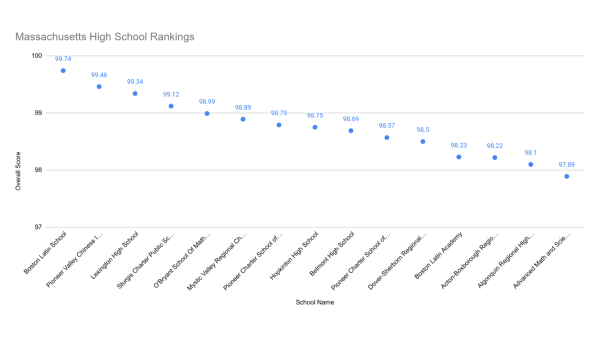
AMSA, which was No. 4 in the U.S. News and World Report’s Massachusetts Best High Schools rankings for the 2024-2025 school year, has dropped to No. 15 for the current school year.
Boston Latin School and Pioneer Valley Chinese Immersion Charter School maintained their first- and second-place rankings, respectively, from last year.
Until this year, AMSA had never been ranked outside the publication’s top 10.
Is it viewed internally as a cause for concern?
“It’s nice to have a ranking as No. 15 or three or seven or where we’ve been,” Principal Mike Nawrocki said. “But I don’t think it’s like we need to celebrate it or get down about it, because we need to focus on what we’re doing here and not outside perspectives.”
How are these rankings actually generated, what do they mean, and why did AMSA drop?
U.S. News and World Report bases its ranking of schools on six weighted metrics: college readiness weighted at 30 percent, state assessment proficiency weighted at 20 percent, state assessment performance weighted at 20 percent, graduation rate weighted at 10 percent, college curriculum breadth weighted at 10 percent, and underserved student performance weighted at 10 percent.
All of these factors and their weights are put together to create one general score out of 100 percent. AMSA scored a 97.89.
The percentage distribution of certain metrics amongst AMSA students according to U.S. News and World Report includes: 76 percent of students took at least one AP Exam, 62 percent of students passed at least one AP Exam, 91 percent of students exhibited mathematics proficiency, 86 percent of students exhibited reading proficiency, 80 percent of students exhibited science proficiency, and 99 percent of students graduated high school.
AMSA’s proficiency rates in mathematics, reading, and science are reflective of MCAS scores.
The statistic for the amount of students who passed at least one AP exam was calculated in two parts. The first part, weighted at 25 percent,was simply the amount of seniors who took at least one AP exam divided by the total number of seniors for the 2022-2023 school year. The second part, weighted at 75 percent, was the amount of seniors who earned a score of three or above on at least one AP exam divided by the total number of seniors for the 2022-2023 school year.
The quantitative metric measured by U.S. News and World Report does not include any qualitative data about the school, such as student fulfillment and the quality of the community created by the school.
“This is a consumer magazine that’s rating schools across the United States of America,” Mr. Nawrocki said. “No one representing this organization has ever been here.”
The validity of the ranking seems to be a divisive topic, with arguments for and against AMSA taking this ranking seriously. Some perspectives place teaching students to exhibit a good work ethic and critical thinking skills over raw standardized test scores.
“[AMSA’s coursework] sets up students for success after AMSA, whether it’s military, whether it’s right to a career, or whether it’s to college,” Executive Director Dr. Lisa Mobley said. “Mr. Nawrocki and his team have done some work […] in trying to identify student satisfaction, student happiness.”
Standardized tests can only measure how well the student did on that specific test, and thus they are unable to paint a complete picture of the education a student received.
“Ninety-one point six percent of AMSA students take advanced coursework,” Dr. Mobley said. “So that’s AP and what AMSA considers beyond AP [accelerated courses].”
AMSA students are doing worse, on average, on AP tests than other top schools in Massachusetts. Nevertheless, AMSA continues to provide an opportunity for its students to take rigorous classes.
“In terms of educational quality, we haven’t — at least in my noticing and knowledge — we haven’t dropped significantly,” student body President Jackson Molloy said. “Teachers, extracurriculars, all of the things that we as a school offer have not changed.”

Other perspectives place emphasis on the ranking as a metric that the staff and students at AMSA should be considering, as they provide a standard that AMSA students need to meet.
“It’s undeniable that when you see Boston Latin School when they’re ranked really high, they’re obviously a phenomenal school,” student body Vice President Arya Sheth said. “And so ranking does play a significant role in saying how good a school is.”
Boston Latin is a test school, which means that testing is required to get in. In doing this, the administration at Boston Latin is ensuring that the academic rigor and students’ ability to meet it are to its standards.
AMSA’s drop in the ranking seems to stem mainly from students’ underperformance in standardized testing in comparison to other top schools. Even if test scores do not provide a complete picture of a student’s education, some still see them as a key indicator of the standards AMSA students need to meet.
“I personally believe that to be a product of how our school handled Covid,” Jackson said. “I feel like that is what affects test scores for high schoolers the most right now, missing out on that educational period during the pandemic.”
It has now been more than four years since the pandemic ended.
The source of why AMSA students are doing worse on standardized tests in comparison to students from other schools seems to also be a very divisive topic. One argument blames the lower scores on a lack of student passion.
“I think it displays a recurring theme in the level of rigor that AMSA has seen decline over the past however many years,” said science teacher Robert Bishop, who is also a member of AMSA’s first graduating class. “I think that stems from both the teachers reducing student workload and the students not caring as much about education as they have in the past.”
This call back to AMSA’s history was a common point: AMSA once had a higher ranking arguably because students in the past simply cared more about education.
“If we went four or five, maybe even six years ago, the students were very motivated, and so […] people who applied [for admission] were students who really liked math and science,” Arya said. “And then eventually it kind of broadened to like, if everybody just applies to AMSA, right, then it’s a good school and hopefully my child will be educated, but it wasn’t like the child wanted to go to the school.”
The argument that some AMSA students lack academic drive opens up an entirely new can of worms: How does AMSA get its students to care more about education?
“[AMSA] needs to re-evaluate the people who are at the school, in the sense of the student population, because there are kids who clearly do not want to be here,” Mr. Bishop said. “Because they don’t want to be here, it affects the environment of the people that are around. It affects the environment of the teachers that are around. It affects everything.”
Some of the schools ranked above AMSA are test schools, which means that they maintain academic excellence via testing to determine admission.
“Being a charter school, I don’t know if we have a lot of say over what students we can actually get into AMSA,” Arya said. “I think at AMSA we can definitely have a little bit more rigor in our teaching. We can have a clear curriculum.”
Regardless of the causes and the seriousness of the issue, the fact remains that AMSA slipped from No. 2 to No. 15 in four years.





Jackson Molloy • Dec 13, 2025 at 11:06 pm
I loved the article! My one gripe though is that it’s not the fault of the kids. It’s how our school responded to Covid. The classes of 2024 and 2025 took it the hardest. They were online during eighth grade and ninth grade. Other schools in that list above us provided more support.
As Mr. Nawrocki suggested too, the rankings are arbitrary and only reflect numbers: not how they are achieved. For example, some of the schools high up on that list of 15 only let kids with straight As and A+s take their AP classes to artificially inflate the AP scores for the school. Our school however, is far more lenient. But that’s not a bad thing. That means we are pro student and pro opportunity. That means that we will challenge our students regardless of what the numbers say.
And again, we absolutely took a hit from Covid. But, we are making a slow, sure, but certain recovery. Our rankings are going up. We continue to provide opportunities: academic, extracurricular, and beyond that reorient and encourage students to achieve excellence at AMSA after something as disorienting as a pandemic. We need to put our faith in our students, and our staff members. We are doing a great job. For now, let’s keep providing for each other and let’s recognize that the rankings are superficial. Quoting Mr Nawrocki once more, “no one representing this organization has ever been here.”